

Your coffee table sits right at the visual center of your living room, yet it is often the first surface to collect stray mail, tangled phone chargers, and random coasters. On the flip side, clearing everything off leaves the center of your seating area feeling bare, cold, and unfinished.
Learning how to style a coffee table does not require an expensive shopping spree or an art degree. Interior designers rely on repeatable visual recipes that balance height, shape, and texture while leaving plenty of open space for your morning mug or evening snacks.
Whether you own a sleek round marble table, a chunky rustic wood slab, or an upholstered ottoman, these seven foolproof formulas will help you style your centerpiece effortlessly.
The 3 Golden Rules Before You Start
Before arranging a single object, keep three basic design habits in mind so your table looks curated rather than cluttered:
- Vary your heights: Grouping three flat items together looks dull. Pair a tall vase or branch arrangement with a medium stack of books and a low dish or candle so your eye moves naturally across the surface.
- Mix shapes and materials: If you have a sharp rectangular table, soften it with a round tray or a curved ceramic bowl. Contrast smooth glass or marble with rough woven rattan, raw wood, or matte stoneware.
- Leave 40% breathing room: A coffee table still has to work hard for everyday living. Keep at least forty percent of the surface completely open so guests have a comfortable spot to set down a glass.
7 Foolproof Designer Coffee Table Formulas
Pick the formula below that best matches the shape and size of your table, then shop your own bookshelves and kitchen cabinets before buying anything new.
1. The Classic Triangle Formula (Best for Square & Rectangular Tables)
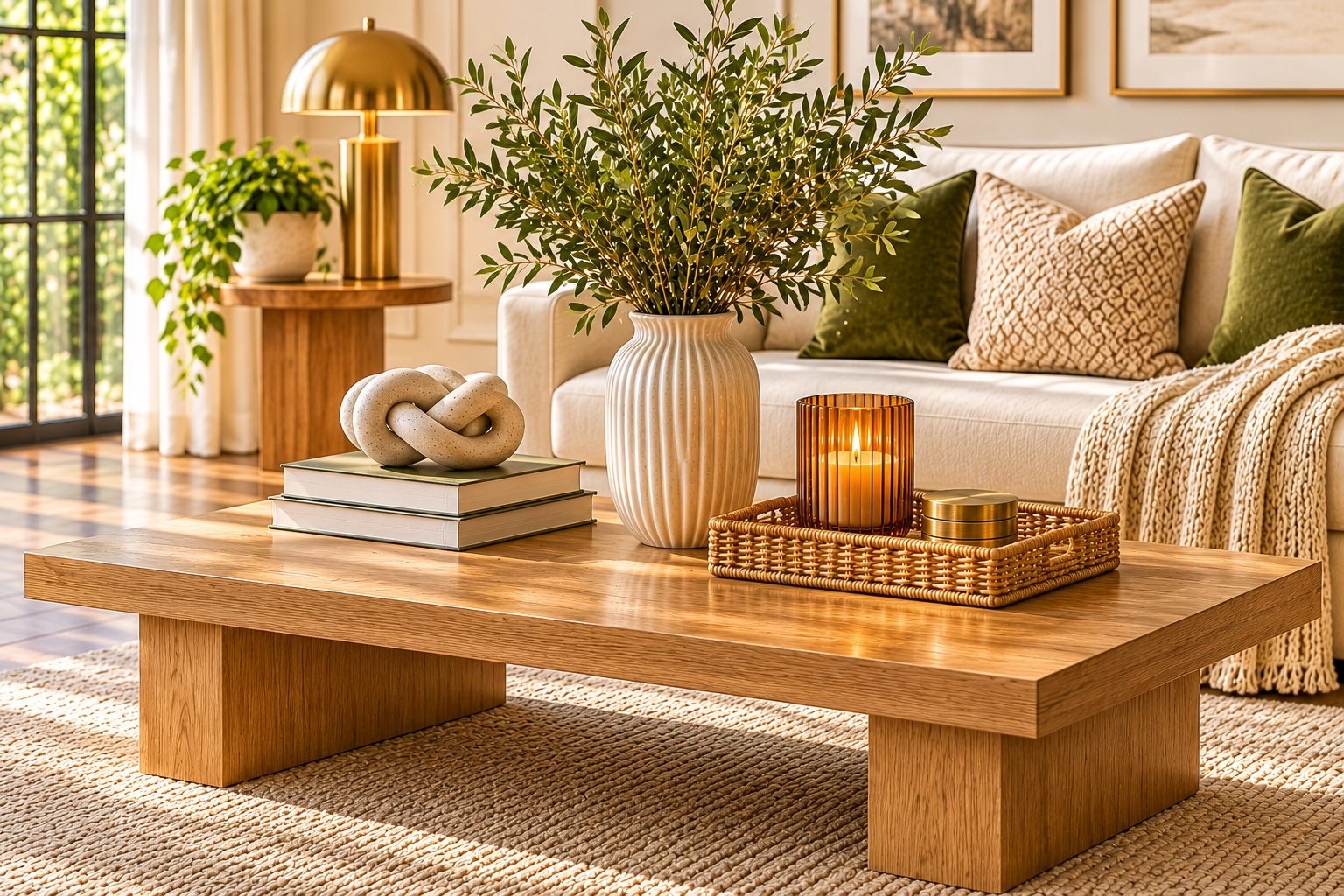
Interior designers almost always arrange objects in threes because odd-numbered groupings feel organic and relaxed. Imagine a triangle drawn across the center of your table and place one anchor element at each point.
At the first point, lay down two or three hardcover books stacked from largest to smallest. At the second point, add height with a medium ceramic vase filled with fresh eucalyptus or seasonal stems. At the third point, place a low decorative bowl, a sculptural wooden chain, or a scented candle to anchor the triangle.
2. The Tray and Two-Object Rule (Best for Upholstered Ottomans)
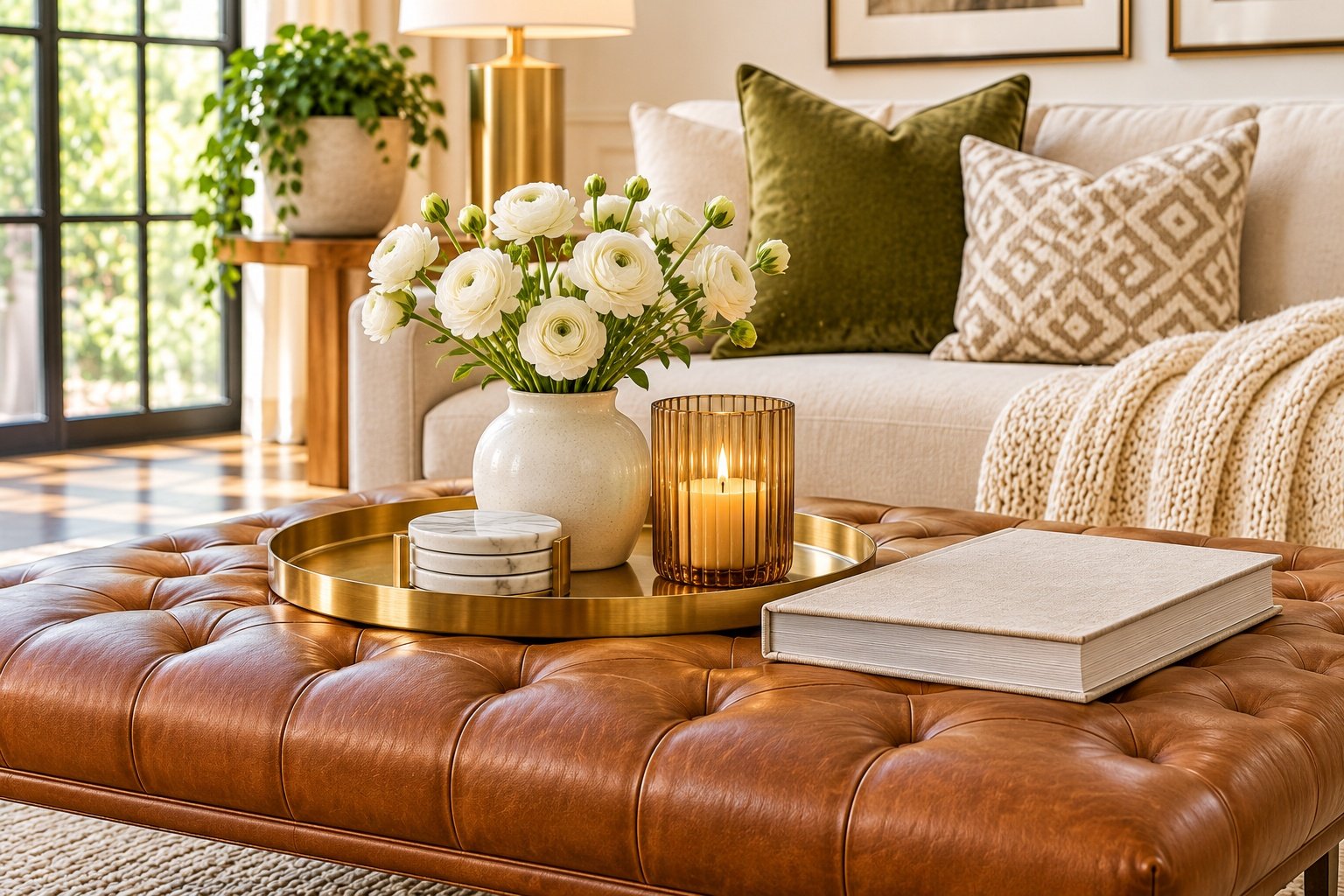
Styling a soft fabric or leather ottoman is tricky because drinks wobble and small objects sink into the cushions. A rigid tray solves the problem immediately by creating a flat, stable island in the middle of the upholstery.
Choose a large wooden, mirrored, or woven tray that covers roughly one-third of the ottoman. Inside the tray, place a small bud vase with fresh flowers alongside a coaster stack and a candle. Outside the tray, lay a single oversized coffee table book flat on the cushion to balance the visual weight.
3. The Round Table Split (Best for Circular & Oval Tables)
Round coffee tables eliminate sharp corners in tight walkways, yet arranging items in a straight line across a circle looks awkward. Instead, divide the circle visually into three pie wedges or group everything tightly into one central cluster.
Place a low, wide wooden pedestal bowl slightly off-center, tuck a pair of stacked books right beside it, and finish with a tall, slender taper candle holder or trailing plant. Keeping the arrangement tight toward the middle leaves a generous outer ring open for drinks all the way around.
4. The Four-Quadrant Grid (Best for Oversized Square Tables)
Large square coffee tables often swallow up small decor pieces, making them look lost in a sea of wood or stone. Dividing the tabletop into four equal imaginary squares brings instant order and structure to big surfaces.
In quadrant one, place a woven catch-all tray for remotes and matches. In quadrant two, stack three architectural or travel books topped with a brass magnifying glass or stone paperweight. In quadrant three, add a lush potted fern or tall branch arrangement, and leave quadrant four completely bare for everyday use.
5. The Low-Profile Minimalist Duo (Best for Small Living Rooms)
When your living room is compact, towering floral arrangements can block your view of the television or interrupt conversation across the sofa. Stick to just two low, sculptural pieces so sightlines stay wide open.
Pair a long, shallow carved wood dough bowl filled with moss balls or decorative beads with a single stack of two neutral-toned books. You get rich organic texture without adding visual bulk to a small room.

6. The Organic Nature-Inspired Mix (Best for Boho & Coastal Rooms)
If your space leans relaxed, earthy, or coastal, let raw natural textures take center stage instead of shiny metals or formal books. This formula feels effortless and collected over time.
Start with a seagrass or rattan tray to ground the center of the table. Add a weathered terracotta jug holding dried pampas grass or olive branches, a piece of sculptural driftwood or travertine stone, and a chunky beeswax pillar candle. The mix of matte clay, woven grass, and warm stone instantly softens a plain sofa.
7. The Symmetrical Double-Stack (Best for Long Narrow Tables)
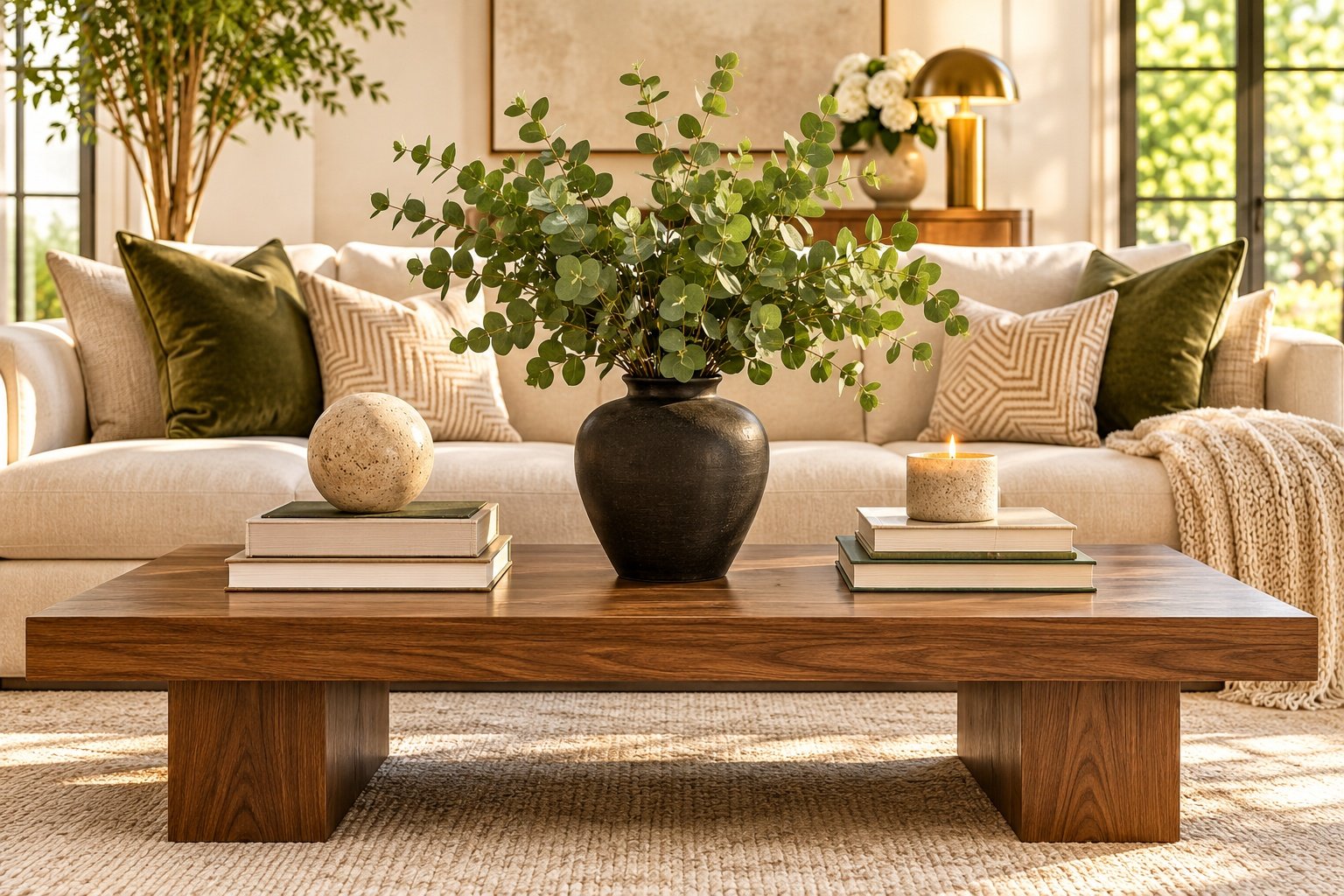
Long, narrow coffee tables built for deep sectionals can look lopsided if you push everything to one end. Creating loose symmetry across both halves of the table brings calm visual balance to extended seating areas.
Place two equal-height stacks of hardcover books on either side of the table’s centerline. Top the left stack with a small sculptural object like a ceramic knot, and top the right stack with a low scented candle. Set a single medium vase with fresh greenery right between the two stacks to bridge the gap.
Common Coffee Table Mistakes to Avoid
Even great decor pieces can look off if the proportions do not match your furniture. Watch out for these quick pitfalls when putting your arrangement together:
- Choosing items that are all the same scale: Three tiny trinkets scattered across a five-foot table will always look like clutter. Anchor your setup with at least one substantial piece, such as a 12-inch tray or a wide bowl.
- Blocking eye contact: Keep tall stems and branches off to one side rather than dead center if people regularly sit across from each other to talk.
- Forgetting functional storage: If remote controls and reading glasses always end up on the table anyway, embrace it by including a lidded decorative box so those daily essentials disappear in seconds.
Styling your coffee table is one of the fastest weekend refreshes you can do because it costs little to nothing and instantly elevates the whole living room. Start by clearing the surface completely, picking one of the formulas above, and shopping your own home for books, bowls, and greenery. Which of these seven formulas matches your coffee table shape best?